
Ham radio isn’t just an old-school hobby confined to dusty basements; it’s a global passport to wireless experimentation, space communication, and vital emergency readiness. Whether you want to bounce a signal off the ionosphere to reach Antarctica or chat with astronauts on the ISS, it all starts with a license.
But if you dive into the requirements, you are quickly hit with a wall of alphabet soup: Technician, General, Extra, CW, HF, VHF. It is enough to make any aspiring operator switch off the rig before they even plug it in.
It doesn’t have to be confusing. This guide breaks down exactly what each modern license class lets you do, outlines a systematic roadmap to progress through the ranks, and uncovers the surprising history of how we got here.
Ancestry of the Airwaves
Before diving into today’s licenses, it helps to understand how we got here. Modern ham radio was shaped by decades of evolution and a few massive regulatory shakeups. Knowing this history will help you decode the lingo when chatting with “old-timers” on the air.
The early 1900s was sometimes considered the Pioneer Era. There were no “classes.” If you wanted to operate a spark-gap transmitter, you just had to prove you wouldn’t cause absolute chaos on the airwaves.
As the spectrum grew crowded, the FCC introduced a ladder system: to get the best frequencies, you had to earn them. This gave rise to the Novice Class (the classic entry point requiring 5-words-per-minute Morse code) and the Advanced Class (a notoriously tough bridge between general and expert).
By 2000, the FCC stopped issuing new Novice and Advanced licenses to streamline the hobby. Then came the real game-changer in 2007: the FCC dropped the Morse code requirement entirely for all license classes, opening the floodgates for a new generation of digital and voice operators.
Key Takeaway: You don’t need to know a single dot or dash to get started today. But this history explains why some operators still hold unique, “grandfathered” licenses, and why the remaining three tiers exist.
The Technician License
The Technician Class is the entry-level ticket for nearly every modern radio operator. It is designed to get you on the air quickly, safely, and with a minimal learning curve. All Ham operators start here.
Don’t let the entry-level label fool you. A Technician license gives you full operating privileges on all amateur frequencies above 30 MHz, opening up some truly incredible doors for new operators. For starters, you gain access to the highly popular 2-meter and 70-centimeter VHF and UHF bands, which are perfect for crystal-clear local and regional communication. It’s the bread and butter of daily ham radio chatter, community volunteering, and emergency readiness.
But the capabilities stretch far beyond your local neighborhood. Through clever internet integration, you can link your radio to global digital networks like DMR or EchoLink, allowing a simple handheld radio to connect with operators on the other side of the planet. If you want to aim even higher, the Technician license grants you entry into space communications. With just a basic directional antenna, you can “work the birds”—bouncing your voice or data signals off amateur satellites orbiting Earth, and even catching a rare, unforgettable chat with astronauts aboard the International Space Station.
Is This Right for You?
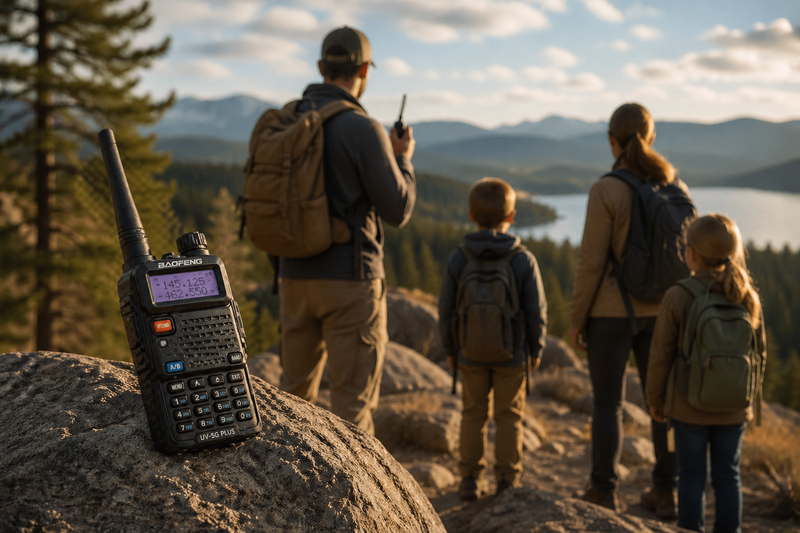
This level is perfect for hikers and overlanders needing off-grid communication, emergency prep enthusiasts joining local networks like ARES (Amateur Radio Emergency Service), and anyone who wants to chat with the local community through neighborhood repeaters.
What to Expect?
If you decide this is the right class for you, expect a 35-question multiple-choice quiz covering basic safety, FCC regulations, and fundamental electronic theory. You only need to get 26 questions right to pass. While there is typically a small testing fee, this isn’t the cost of the actual license. Once you’ve passed the test and the information is submitted/approved by the FCC, expect a $35 fee to obtain your callsign which is good for 10 years.
The General License
If the Technician license gets your foot in the door, the General Class license blows the door completely off its hinges. This is the mid-tier license, and it represents the single biggest jump in radio privileges you can achieve.
The General license unlocks the legendary shortwave spectrum, granting you massive access to the vast majority of the High Frequency (HF) bands from 10 all the way through 160 meters. With this upgraded access comes the ultimate amateur radio superpower: atmospheric bouncing. Instead of being restricted by line-of-sight limitations or relying on local internet infrastructure, you gain the ability to launch your signals directly into the sky, bouncing them off the Earth’s ionosphere via skywave propagation to communicate across continents and oceans using nothing but the atmosphere and your radio.
Is This Right for You?
The General license is the ideal choice if you are ready to transition into true, infrastructure-independent global communication. If your goal is to establish direct, long-range contacts with stations as distant as Japan, research installations in Antarctica, or maritime vessels navigating the Atlantic Ocean, this tier provides the necessary frequency privileges. It is a perfect fit for operators who want to move beyond local line-of-sight repeaters and master the mechanics of High Frequency (HF) transceivers and resonant antennas. If you want a global reach that operates entirely separate from commercial internet or cellular networks—relying solely on your hardware setup and the shifting dynamics of the Earth’s ionosphere—upgrading to General is your logical next step.
What to Expect?
After passing Technician Class, expect another 35-question multiple-choice exam requiring a score of 74% (at least 26 correct answers) is needed for this license. While the regulations are similar to the Technician level, this test dives deeper into intermediate electronics, transceiver circuitry, and the science of radio wave propagation (predicting how and when signals travel). It strictly focuses on technical and practical application. Similar to the Technician License, morse code is not required or tested. Financially, expect a small testing fee for the administration of the exam; however, the FCC does not charge an additional $35 application fee for the license upgrade.
The Amateur Extra License
The Amateur Extra Class is the highest level of license you can achieve in the amateur radio service. It is the gold standard of the hobby, indicating that an operator has mastered the technical and regulatory aspects of the craft.
Achieving the Amateur Extra license grants you the ultimate level of operating privileges, starting with total frequency freedom. You unlock every single hertz of allocated amateur radio spectrum, completely eliminating the boundaries and restricted windows that limit lower-tier operators. This includes exclusive access to premium, quiet slices of bandwidth at the very bottom of the high frequency (HF) bands—the exact frequencies where rare foreign stations (DX) operate and high-stakes international contesting takes place. Beyond operating privileges, you also earn mentor status within the community by qualifying as a Volunteer Examiner (VE). This allows you to officially administer exams, grade tests, and directly license the next generation of radio operators.
Is This Right for You?
Aside from bragging rights, the Amateur Extra class is tailored for operators focused on precision, technical mastery, and competing at the highest levels of the hobby. This tier is designed for the dedicated hobbyist who aims to hunt down the rarest, most remote stations on Earth, build advanced radio gear from scratch, or secure a highly coveted, ultra-short “vanity” callsign (such as a 1x2 or 2x1 format). If you want to eliminate all frequency restrictions, maximize your contesting edge, and participate in the peak engineering and operating challenges amateur radio has to offer, reaching this final tier is your ultimate objective.
What to Expect?
Unlike the prior to classes, expect a rigorous 50-question multiple-choice exam with a passing score of 74% (at least 37 correct answers). This test skips the basics and dives straight into advanced electronic circuits, digital signal processing, satellite orbital mechanics, and complex radio frequency safety; Morse code proficiency is no longer required or tested. Like with the other classes, expect an administrative fee to host the exam and the FCC does not assess an additional $35 application fee for a license upgrade.
What’s Next?
At the end of the day, there is no single “right” way to enjoy amateur radio. Every license class offers a completely different doorway into the hobby. There is absolutely no shame in staying a Technician forever if local repeaters, digital networks, and satellite hacking keep you smiling. But if you feel the pull of the horizon, the global airwaves are waiting for those willing to climb higher.
The secret to getting started is simply to stop overthinking it. Everyone starts with a Technician class but the sky is the limit. Pick a target date, download a study app, and get ready to earn your callsign. We can’t wait to hear you on the airwaves!